The next visibility crisis is not bad SEO. It is becoming invisible to AI.
Most websites were built for humans and traditional search engines. AI engines need clearer identity, structure, access, context, trust, and accessibility signals. When those are missing, the problem is silent: the website looks fine, but AI may misunderstand or overlook the business.
Your site can look beautiful and still be difficult for AI to understand.
Soren makes that invisible problem visible. It explains what AI sees, what is missing, what already works, and what can be improved—without overwhelming the user with technical jargon.
People increasingly ask AI for recommendations instead of opening ten search results.
It looks for identity, services, location, authority, context, and consistency.
Soren turns technical signals into a clear, actionable explanation.
A full readiness scan—not someone pasting your website into a chatbot.
The toolkit checks the technical, structural, accessibility, security, and monitoring signals that help humans and AI understand your website more clearly.
AI-readable identity
Company, product, service, location, founder, and factual entity information.
llms.txt readiness
Clear AI-facing summaries and machine-readable product context.
AI crawler access
robots.txt rules for major AI crawlers and retrieval systems.
Structured data
JSON-LD and Schema.org signals for products, organizations, people, and services.
Accessibility basics
Alt text, headings, form labels, landmarks, contrast, and common usability improvements.
Security hardening
Recommended browser security headers and visible configuration weaknesses.
Discoverability signals
Sitemap, canonical URLs, Open Graph, metadata, and semantic page structure.
Monitoring readiness
Ongoing checks that alert you when updates reduce your score or remove important signals.
Start with a website. Use Soren when conversation makes the process easier.
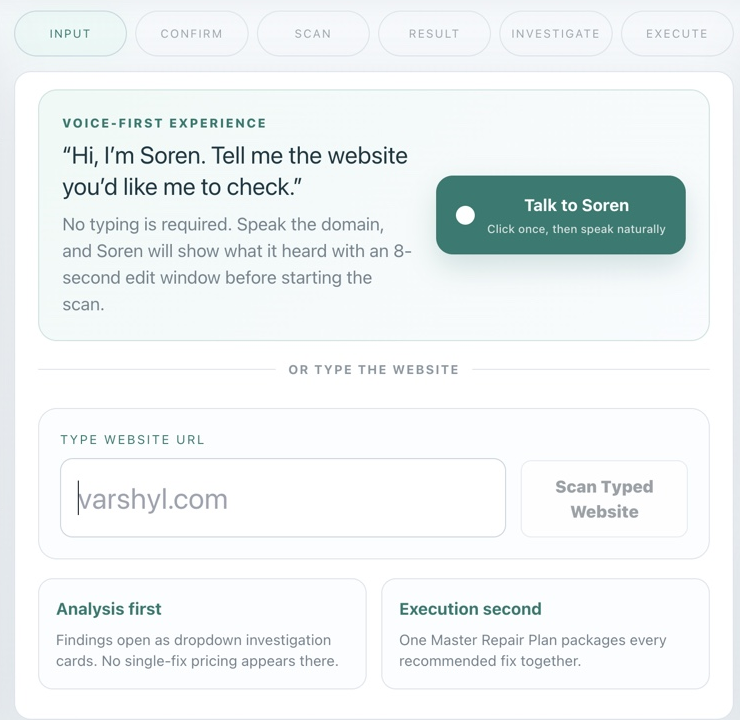
The fastest path starts with typing the website.
Visitors first type the website and start the free scan. Soren remains available as an optional voice feature for people who prefer natural conversation, guided explanations, or hands-free help.
Ready to see what AI understands?
Type the website first. This launches the free audit. Soren voice assistance remains available inside the scanner when the visitor wants it.
Built in public. Open to inspection. Designed to improve the internet.
The toolkit is published on GitHub so developers, agencies, and business owners can inspect the source, review the logic, contribute improvements, and verify what is being added to their website.
Not a black box.
No mystery installer and no hidden executable. The open-source package can be inspected before use. Paid services cover AI processing, automation, guidance, implementation, and monitoring—not access to secret code.
See what AI understands about your business.
The audit is free. The explanation is clear. You can review every finding before deciding whether to fix it yourself or ask Soren to help.